

Beyond the Bottom Line: Rethinking the Value of Enterprise in the North East
Enterprise is often framed as a numbers game: more start-ups, faster growth, higher productivity. But what if this narrow focus is missing much of what enterprise actually does for places like the North East of England?
A new report, Beyond the Bottom Line: How Enterprise Drives Inclusive Growth, published today by Innovation Catalyst, in partnership with Insights North East and Durham University, argues that enterprise plays a far broader role in regional development than traditional metrics suggest.
Drawing on research with entrepreneurs, enterprise support providers, and policymakers across the North East, the report shows that enterprise contributes not only to economic output, but also to skills, resilience, opportunity, community wellbeing, and long-term place-based development. Rather than rejecting growth outright, the report reframes how growth should be understood, what enterprise and enterprise support contributes to growth —and what policymakers should value and measure. Three key findings stand out.
Many contributions of enterprise are invisible in traditional growth metrics
Dominant measures of enterprise success capture only a fraction of its real regional value. Policy attention often centres on a small group of high-growth firms, yet the vast majority of businesses in the North East are micro and small enterprises operating in challenging conditions, with limited access to finance, skills shortages, weak supporting infrastructure, and repeated economic shocks.
For many of these firms, “growth” does not mean rapid expansion. It means continuity, adapting business models, retaining staff, and continuing to serve local markets. Such businesses stabilise incomes, sustain local supply chains, and keep everyday services running — especially during periods of crisis.
The report reframes growth through six alternative lenses, including growth as survival, community and place-based growth, and foundational growth. Together, these perspectives show how enterprises contribute to regional prosperity even when they do not scale or increase productivity in conventional ways.
“The implication is clear: when policy equates success solely with expansion, it undervalues the enterprises that quietly underpin economic and social resilience across the region”.
Enterprise support creates value even when no business is formed
Policies and strategies to support enterprise are generally rooted in the assumption that it is only working successfully when it produces new businesses or rapid firm growth. Yet this report challenges that assumption.
The research shows that engagement with enterprise support generates substantial individual-level outcomes, regardless of whether a business is ultimately started. Participants consistently reported gains in confidence, skills, agency, employability, and social networks. These outcomes matter because they do not disappear when a venture stalls or fails; instead, they diffuse into the wider economy and society over time.
To capture this, the report introduces a new model of enterprise value: the ‘diffusion model’. Rather than treating enterprise as a linear pipeline from start-up to scale-up, the model shows how benefits spread across three interconnected levels: individuals, businesses, and society. Value flows in multiple directions—individual development can precede business formation, firm survival can stabilise communities, and societal conditions can enable new enterprise opportunities.
This finding has important implications for evaluation. Treating non-starters or business exits as failure obscures the longer-term value created through skills, confidence, and agency.
Inclusive growth depends on supporting the foundational economy
Much economic strategy prioritises high-tech, export-oriented firms, yet the report shows that much of the North East’s enterprise activity — and employment — sits within the foundational economy or everyday. This part of the economy includes sectors like food, care, retail, transport, local services, and social enterprises.
These businesses are deeply embedded in their place. They provide essential services, employ a disproportionate percentage of people facing labour market barriers, and circulate spending locally. Their value lies less in productivity leaps and more in reliability, access, and community impact.
The research finds that many existing enterprise programmes already support foundational businesses through advice, micro-grants, mentoring, and local delivery networks. However, these contributions are rarely framed as “growth” in policy terms. As a result, foundational enterprises risk being overlooked or judged against inappropriate benchmarks focused on scale and acceleration.
If inclusive growth is the goal, the report argues, enterprise policy must recognise and invest in these everyday forms of business rather than treating them as low ambition or residual.
Rethinking enterprise support in the North East
Taken together, these findings point to a fundamental mismatch between how enterprise value is created in the North East and how it is currently measured and rewarded.
Enterprise already plays a vital role in building resilience, widening opportunity, strengthening communities, and supporting long-term regional development. The challenge is not a lack of enterprise activity, but a policy framework that struggles to value its full contribution.
The diffusion model presented in the report offers a way forward. By offering a framework for understanding and tracking outcomes at individual, business, and societal levels over time, it provides a more realistic and inclusive account of how enterprise works in place.
Getting enterprise support right is a real challenge, particularly in a context of shrinking budgets and growing business needs. But what is clear from Insights North East’s report is that, if the North East’s ambition for more inclusive growth is become a reality, it needs to look beyond the bottom line—and fully value enterprise for all that is delivers to the region.
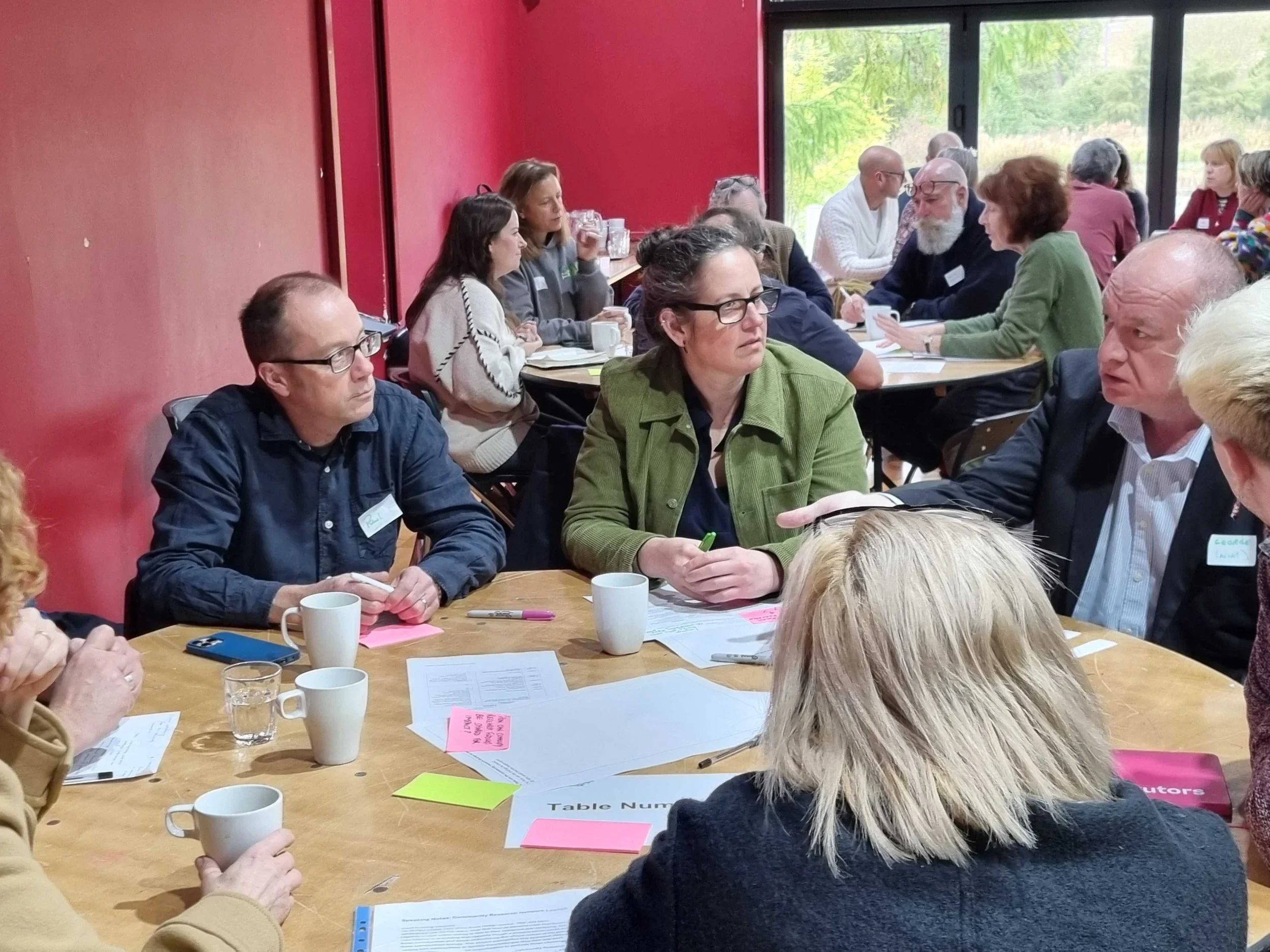
Co-designing an evaluation together: Shaping how we learn and measuring what really matters in Rural County Durham
Launching the Rural Durham Community Research Network
Monitoring and evaluation (M&E) of projects, initiatives and organisations is often seen as a tick-box exercise or something done too stakeholders rather than with them. But when it’s co-designed with a mix of stakeholders in a participatory and inclusive way, M&E becomes an important tool for learning, responsibility and collective impact that really reflects and measures what’s important to those involved.
As part of the Rural Durham Community Research Network (CRN), Innovation Catalyst has been working on behalf of the core CRN partners: the Rural Design Centre, Durham Community Action and Durham University, to co-design the CRN’s M&E framework that is relevant, practical and useful to everyone. Instead of starting with a ready-made model, the network has built it together — through conversations, online workshops and shared reflections — making sure it captures what really matters to people living and working in Teasdale, Derwent Valley and Weardale.
For the purposes of this work, we define “rural” as areas characterised by low population density but with strong local connections, open spaces and natural environments often with limited access to services compared to urban areas. Rural communities face unique social, economic, and environmental challenges, and understanding this context is central to meaningful M&E.
At the heart of the process for developing the M&E has been the involvement of our community researchers, core delivery team and voluntary, community and social enterprises (VCSEs) that make up the CRN. Together, they brought local knowledge, experience and creativity into every stage. Their insights have helped shape a framework with a shared purpose, set of principles and values, key evaluation questions and an approach to research methods, collection, analysis and reporting which is practical, iterative and flexible.
By working in this participatory way, we’ve not just designed an M&E framework — we’re strengthening relationships, building shared understanding and ownership, and creating something that will continue to grow and capture the story of change within the network over time.